
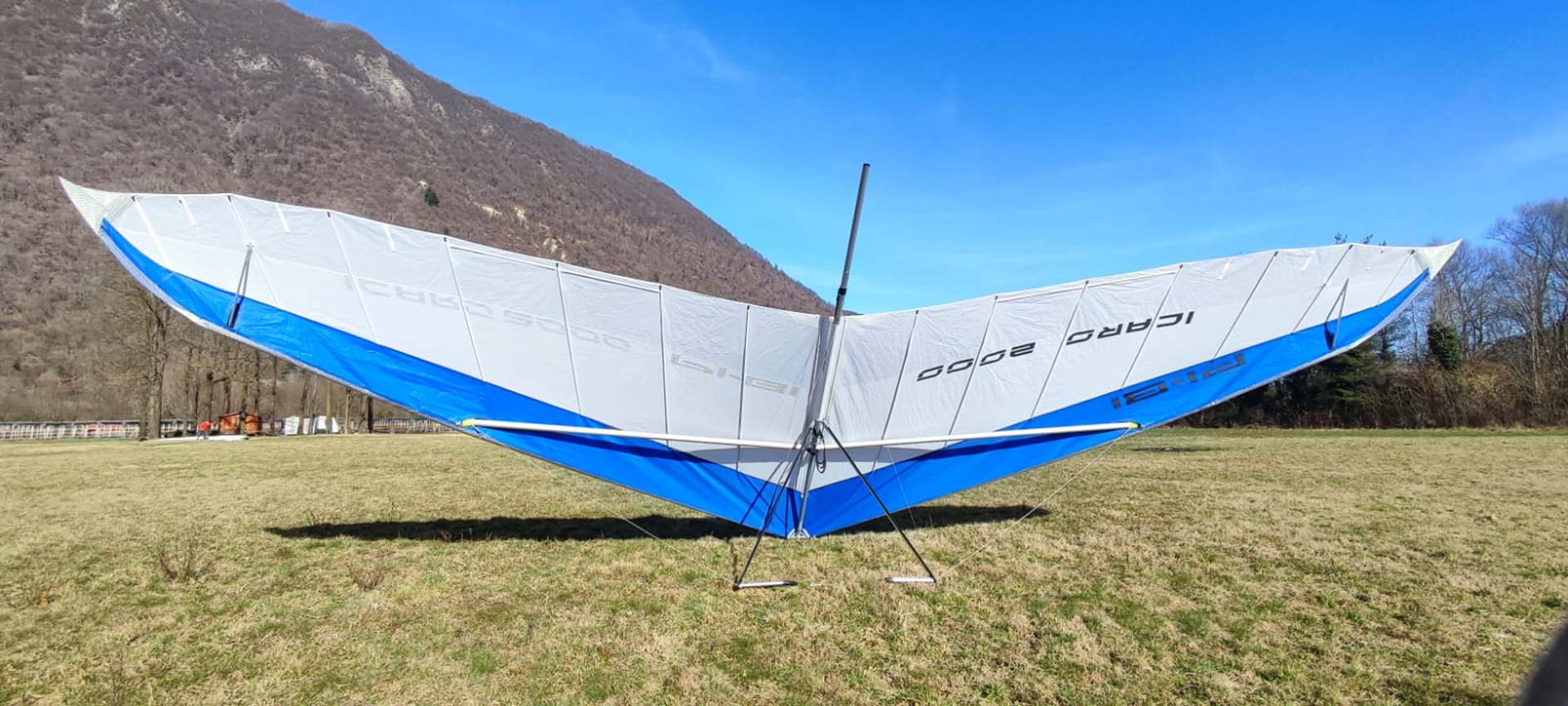
Icaro 2000’s new Pi-Bi tandem hang glider
Icaro 2000’s new Pi-Bi tandem hang glider was developed to provide tandem pilots and instructors with lower take-off and landing speeds, increasing safety for both pilots and passengers.
Conceptually based on the Piuma hang glider, the Pi-Bi achieves this objective through an increase not only in wing area compared to our previous tandem model – from 21 to almost 24 m² – but also in wingspan, which has been increased from 10.82 to 11.2 m and can be extended to 11.5 m when using wingtips.
Despite these increases in size, optimization of the chord distribution and frame geometry ensures that the wing retains excellent handling characteristics. This makes it easier for students, as well as passengers interested in getting a taste of piloting, to acquire flight skills. It also makes it possible to use even the weakest thermals effectively.
The structure, as always manufactured from 7075 aluminum alloy tubing to ensure reliability and the best possible strength-to-weight ratio, has been redesigned to accommodate higher loads while keeping the increase in overall weight to a minimum.
Certified for a maximum take-off weight (therefore everything included), of between 142 and 227 kg (DHV 01-0510-25), the Pi-Bi has a speedbar wide enough to be used simultaneously by both instructor and passenger. At the same time, a single pilot can fly it without difficulty.
The short final glide and the ease of identifying the correct moment to flare are factors that make landing much easier. When flying with a passenger, landing on wheels fitted to the control bar is a very useful option. The Pi-Bi is designed primarily for foot launch, but it is also certified for towing, both by winch and microlight aircraft.
Like the Piuma, in favorable weather conditions the Pi-Bi is also an excellent soaring glider, enabling instructors to give students a more complete flying experience and conduct longer lessons. Its excellent handling and well-balanced control bar pressure help students master the techniques they will later use during their first solo flights.
In short, the Pi-Bi is an exceptionally reliable tandem hang glider, offering the lowest take-off and landing speeds in its category, together with excellent soaring performance.
Notable features
Like all our other hang gliders, the Pi-Bi incorporates a number of characteristic Icaro 2000 features:
• One-piece leading edge without Mylar pockets, ensuring perfectly even tension distribution.
• Two nose battens, which remain permanently inserted and ensure perfect sail tension in the central area.
• Elasticated nose cone, which can be fitted without lifting the hang glider’s tail – particularly useful in windy conditions.
• Zips at the crossbar/wing junction, providing easy access for inspection.
• Battens integrated into the trailing edge by means of a snap-lock system, providing a clean finish and the possibility of fine sail tension adjustment.
• Micrometric adjustment of tip wand position.
Frame
As for all aircraft, the frame of a hang glider must be both strong and lightweight. This is particularly important for tandem hang gliders: the wing has to support the load of two people, while during every phase of operation it has to be handled using the strength of just one person at a time. For this reason, the use of 7075 Ergal aluminum alloy, together with carefully optimized reinforcement structures, is essential in creating a wing that combines structural strength with easy handling.
Development work on the Pi-Bi has enabled us to retain excellent handling characteristics while increasing the certified maximum take-off weight by 10 kg* when compared to our previous tandem hang glider model.
* NB: 227 kg is the certified maximum take-off weight (MTOW). This figure was obtained as the maximum equivalent load during the negative load test at -3 g.
During the positive load test at +6 g, the wing achieved an equivalent maximum load of approximately 235 kg without structural failure.
Sail
Just like the frame, the sail of a tandem wing requires fabrics and reinforcements capable of meeting the demands imposed by both higher loads and the need for easy handling. For this reason, the central reinforcements and keel pocket have been redesigned, while the use of a Square fabric is strongly recommended. The new “170 OD,” supplied as standard, provides excellent ripstop properties while remaining lighter and softer than the Square Dacron that was used previously.
On request, the Square fabric can be replaced by colored fabric. A Technora sail is also available as an option. With these optional sail configurations, additional specially-designed heavy-duty reinforcements are added to the trailing edge.
Other features
• Profiled uprights with rubber grips
• Floating crossbar
• Elliptical wingtips, which also determine a shorter packed length when compared to a wing with truncated tips
• Profiled kingpost
• Just seven (7) battens per side
• Reinforced upright fittings, available on request, for use with a fixed undercarriage for tow launching